
What Can Jazz Teach Us About Social Skills?
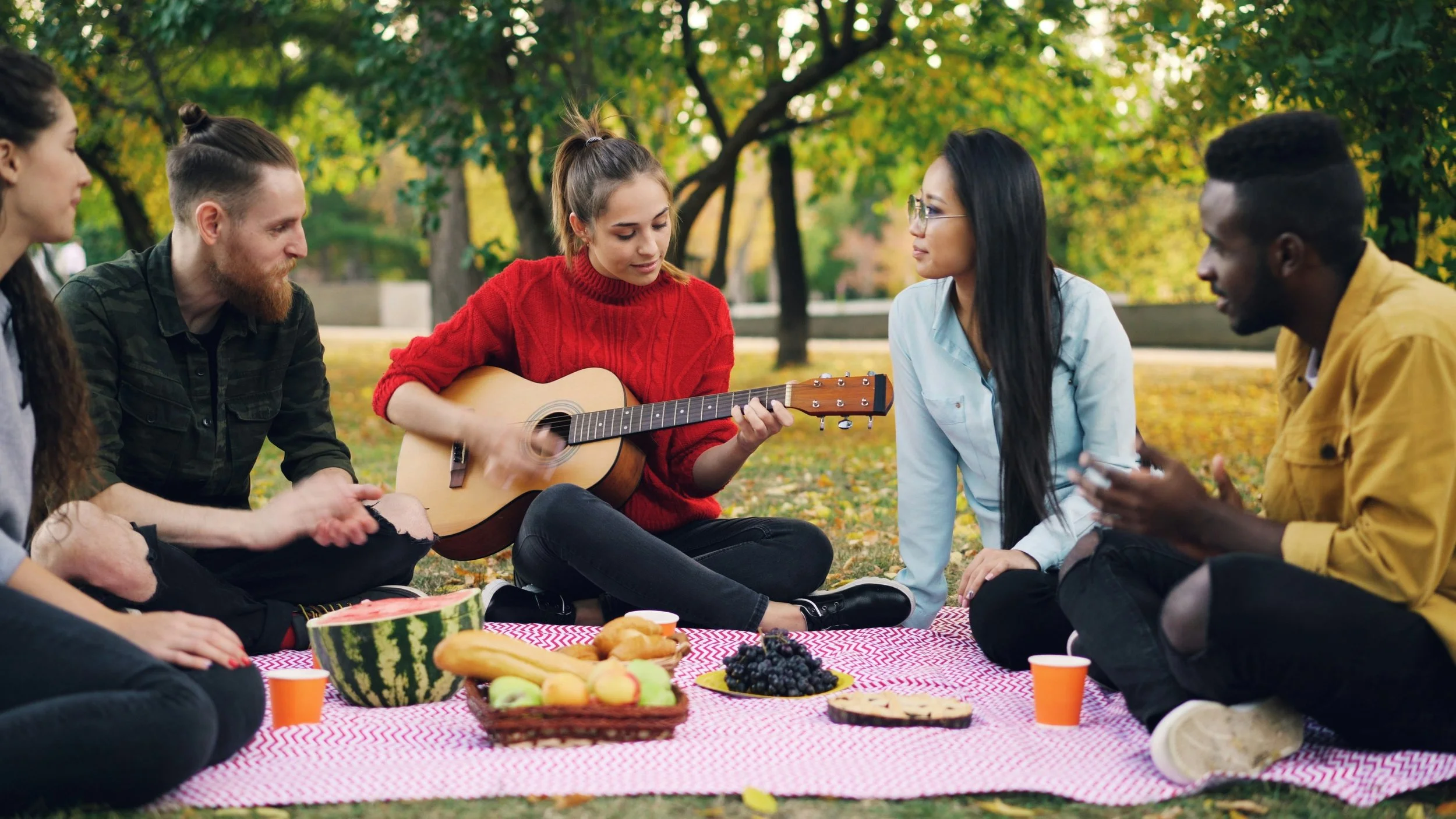
I've been listening to Norah Jones a lot lately. There's something about the unhurried pace of it all, the way the musicians seem to breathe together. I’ve come to realise that there's a moment in a jazz performance that most people miss.
It's not the solo. It's what happens just before the solo ends. The musician's subtle nod, the slight lean, a held note that signals to the rest of the band: your turn. No words. Just years of practice and pattern recognition.
Building the confidence to trust that the group will catch you.
As we’ve been preparing for our new groups to begin in May, I’ve been thinking about that moment and how we see something so similar in our run-of-the-mill, non-musical lives. It’s actually one of the things which drew me to PEERS® (Program for the Education and Enrichment of Relational Skills).
Jazz musicians have long described what they do on stage as ‘having a conversation’, not only as a metaphor, but as a literal description of the process. Neuroscience agrees. When neuroscientist Charles Limb put jazz musicians inside brain scanners and asked them to improvise, he found that Broca's area, the region most associated with language and speech, activated strongly during improvisation. The brain clearly doesn't draw a clean line between musical and verbal communication. When a musician responds to their bandmate's phrase with one of their own, the neural processes involved look remarkably like those that fire during conversation.
Social interaction is a kind of improvisation.
Conversations are often likened to ping-pong, tennis, a give-and-take, in Jazz, the call-and-response. This structure at the heart of jazz is one of the oldest forms of human communication. Rooted in West African musical and oral traditions, it carried through into gospel, blues, and eventually jazz, and it maps precisely onto the structure of conversation. One voice speaks. Another answers. The exchange builds meaning together that neither could have made alone. What looks like musical spontaneity is actually a highly developed social skill: listening closely enough to know what to respond to, and when.
Real, everyday social interaction is far more like jazz than a scripted performance. There's a general shape, but mostly it's improvisation, playing off the people around you, sharing in the connections and experiences you build together.
Just like jazz, nobody is born knowing how.
Even the greats practised their scales for years before they could improvise freely. They learned when to lead, when to follow, when to step back and let someone else carry the melody. The freedom came after the framework.
There's a jazz practice called trading fours. Musicians alternate solos, four bars at a time. You play. I listen. Then I play, and you listen. Back and forth, building on what the other person offered. It's turn-taking in its purest form, and it requires the same skills that underpin good conversation: knowing when your turn begins, what the other person just expressed, and how to respond in a way that keeps the exchange alive.
We make the implicit explicit.
This is what neurodivergent young people are working towards as they build social skills. It's not that they don't want to connect. It's that the conventions that feel automatic to some people need to be made explicit and practised deliberately for others. The nods. The pauses. The signals that say I'm listening, or I'd like to join in, or it's your turn now.
Jazz musicians also live by an unspoken rule: accept what your bandmate offers, and build on it. You don't ignore the phrase they just played and launch into something unrelated, creating an out-of-pocket disconnect. The same applies in everyday conversation. When someone shares something, and the response doesn't acknowledge it, the exchange falters, without malice, but because the signal was missed. One of the things PEERS® does is make these moments visible: what does it look, sound, and feel like when someone is genuinely receiving what you've said?
Research shows that autistic people and those with ADHD are significantly overrepresented in music, particularly in improvised and expressive forms like jazz. And when you think about it, that makes a lot of sense. Jazz has rules, explicit, learnable ones. Twelve-bar blues. Trading fours. The signal to hand over the solo. Those structures are taught, practised, and understood by everyone in the room. Within that framework, there is genuine freedom. And that's exactly what makes it so accessible for brains that work differently.
Social interaction, by contrast, rarely comes with an instruction manual. The rules exist, but they're largely unspoken, assumed, and inconsistently applied. For many neurodivergent young people, that ambiguity is the hard part, not the connection itself.
This is what PEERS® changes. We name the signals, practise the moves, and give young people the same kind of clear framework that jazz has always offered, so that real connection, the kind that feels natural and freely chosen, becomes possible.
And perhaps that makes sense. Jazz has always been the music of people who had to find their own language.
Social skills are learnable. If you'd like to know more about how PEERS® works, we'd love to chat. Book your free discovery call at socialskillsaustralia.com.au