

What if unmasking didn’t mean changing overnight or giving up strategies that help you feel safe? After a late autism diagnosis, a teen or young adult may have new questions about which social behaviours feel comfortable, familiar or protective. Exploring unlearning masking after late autism diagnosis can start with curiosity, not pressure to change.
Masking can include rehearsing conversations, copying social cues or holding back natural ways of moving and communicating. These strategies may have served a purpose, so unmasking doesn’t need to become an obligation.
This guide explores masking without judgement and offers ways to reflect on comfort, safety and personal choice. It also considers how families can support a young person without pressuring them to act differently.
Key Takeaways
- Understand masking as adapting or camouflaging behaviour in response to social expectations, without judging the strategies that have helped.
- Explore why unlearning masking after a late autism diagnosis can bring mixed feelings, and why it doesn’t need to become a goal.
- Use a private reflection table to consider how different settings, strategies, comfort and perceived safety connect for you.
- Try a small change only if it feels right, then review how it felt and adjust or stop at any time.
- Support a young person by listening, asking what they want and respecting their choices rather than monitoring their behaviour.
What does masking mean after a late autism diagnosis?
A late autism diagnosis can bring a new perspective on earlier social experiences. A young person or adult may begin to wonder why they rehearsed conversations, copied others’ ways of interacting or felt worn out after social situations. These questions can help make sense of the past, but they don’t mean every memory needs to be reinterpreted or explained by autism.
Autistic masking is adapting or camouflaging behaviour in response to social expectations, whether consciously or automatically. It can involve hiding or changing ways of communicating, moving or responding to others. The term describes a possible experience, not a diagnosis in itself.
How autistic masking can show up in everyday life
Masking looks different from person to person, and the same person may respond differently depending on the setting. For example, someone might rehearse what to say before joining a group, copy another person’s expressions, force eye contact or hold back movements that help them regulate. These are possibilities, not a checklist or proof that someone is autistic.
A behaviour may be a deliberate choice, a strategy developed to manage social expectations, or something so familiar it feels automatic. It may feel comfortable in one situation and tiring or uncomfortable in another. Autistic masking can include conscious and less conscious ways of camouflaging, which is one reason it may take time to recognise what has been happening.
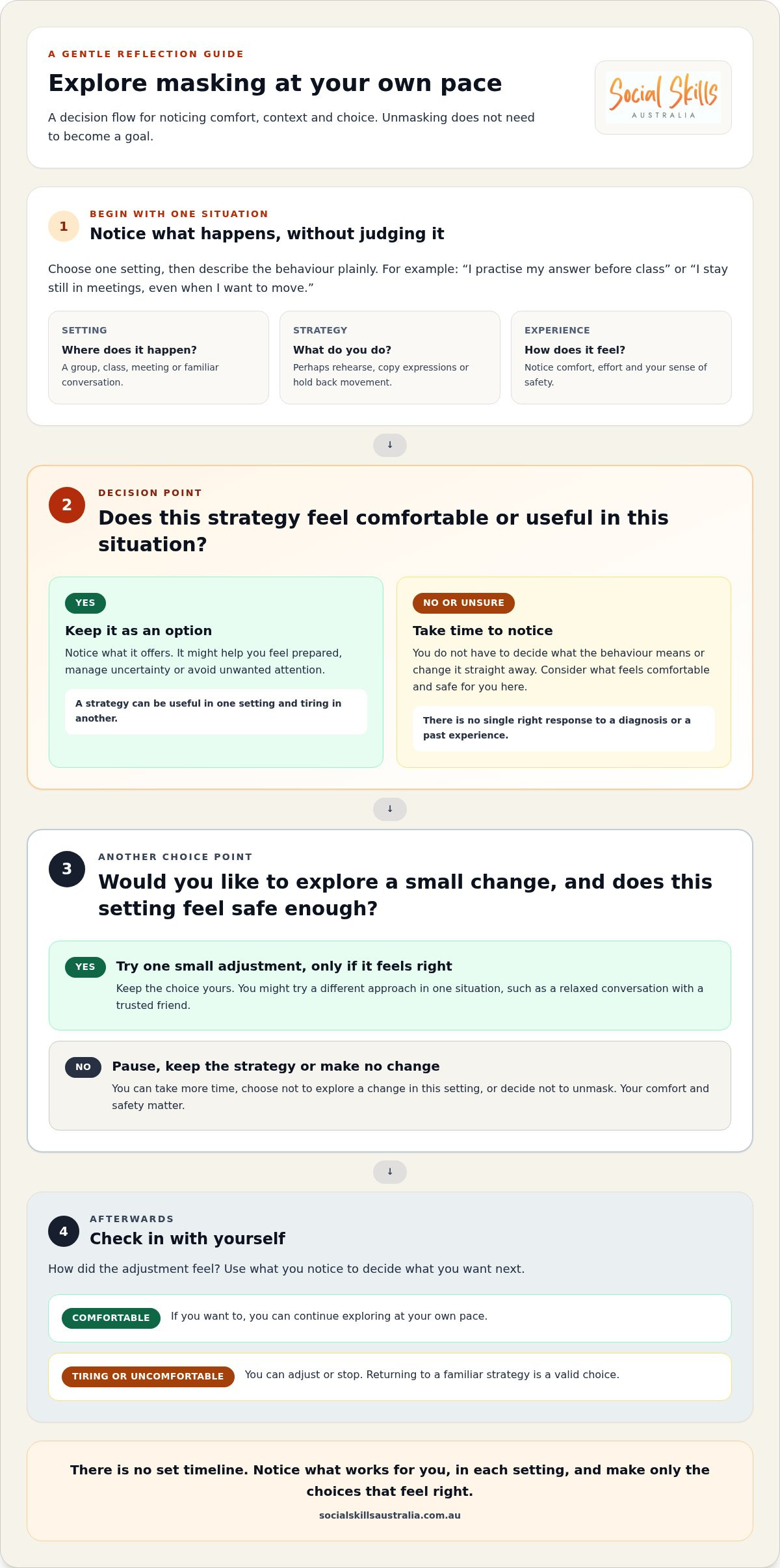
It can help to describe what happens without judging it: “I practise my answer before class,” or “I stay still in meetings, even when I want to move.” A specific observation leaves room to consider what the behaviour does for the person, rather than deciding that it must be changed.
Why a late diagnosis can change how the past feels
A diagnosis may offer a framework for experiences that once seemed disconnected. A young person might understand a difficult group interaction, the effort involved in appearing at ease, or a preference for familiar routines in a new light. This can bring relief or recognition. It can also raise questions about what support might have helped earlier.
Feelings can be mixed. Someone may feel uncertain about which behaviours reflect personal preference and which developed in response to others’ expectations. They may feel sad about past misunderstandings, or have no strong emotion about the diagnosis. There is no single response they need to have.
Not every late-diagnosed autistic person has masked in the same way or sees their past through the same lens. Exploring unlearning masking after a late autism diagnosis may begin with curiosity rather than a plan to behave differently. The person can decide what feels relevant, what they want to keep, and whether any change feels right for them.
Why might unlearning masking feel complicated after diagnosis?
A strategy can be tiring in one situation and helpful in another. Rehearsing what to say might make a new social setting feel more manageable, while keeping up that preparation every day may take energy. A familiar response can also help someone avoid unwanted attention or reduce uncertainty. Its value depends on the person, the setting and what they need at that time.
A diagnosis can offer context for past experiences without dictating what someone should change. For a young person or adult, receiving a diagnosis later in life may bring relationships, school or work experiences into a new focus. The CDC’s information about later autism diagnosis provides context for how diagnosis may occur beyond early childhood, but it can’t determine what any one person’s experiences mean to them.
Some people feel ready to explore different ways of interacting. Others may want to keep particular strategies, take time to understand them, or make no changes. Unmasking isn’t automatically beneficial, and it doesn’t need to become a personal goal. A person’s comfort and safety matter more than meeting an outside idea of what authenticity should look like.
The difference between understanding a strategy and judging it
Instead of asking whether a behaviour is “fake” or “inauthentic”, try asking what it does in a particular context. Does it help someone feel prepared, communicate a preference, manage uncertainty or avoid attention? Does it take energy, or feel comfortable enough to continue? Using a strategy doesn’t make someone less genuine. It may simply be one way they’ve responded to the situations around them.
These questions are for understanding, not for deciding that a strategy must be kept or dropped. A young person might choose to rehearse before a presentation but not before a relaxed conversation with a trusted friend. Both choices can make sense. The aim is to notice what feels useful to the individual, rather than judging their behaviour against a single standard.
Why there is no single unmasking timeline
There’s no set schedule for making sense of a diagnosis or exploring change. Someone might reflect for a while, try one small adjustment, then decide to pause. Another person might not want to unmask in a particular setting, or at all. Comfort can vary across relationships and environments, so changing direction or returning to a familiar strategy is a valid choice.
Unmasking doesn’t guarantee better wellbeing or easier relationships. Other people may need time to understand a change, and some settings may not feel safe for every form of self-expression. Moving at the young person’s pace helps keep their agency central. If they’re interested in learning practical interpersonal strategies, Social Skills Australia’s programs are one optional opportunity to learn and practise social skills, not a treatment for unmasking.
How can you decide where unmasking feels safe and comfortable?
There isn’t one answer for every setting. A behaviour that feels comfortable with a trusted friend may feel tiring at school, work or in a new group. Rather than deciding to change everything, choose one situation to reflect on. The aim is to understand your own experience, not to grade your behaviour or meet someone else’s idea of authenticity.
You could use this private reflection aid to notice how context, comfort and perceived safety connect. It isn’t a test or clinical assessment, and you don’t need to share it with anyone.
Setting: Where does this happen? For example, in class, at work, with a friend or at a family gathering.
Current strategy: What do you do in that setting, if anything? Describe it in your own words.
Personal comfort: How does the strategy feel to you before, during or afterwards?
Perceived safety: How safe or supported do you feel being yourself in this setting? What makes you feel that way?
For instance, someone might note that they use a prepared greeting at a new activity, feel more settled when they have it ready, and aren’t yet sure how the group would respond if they approached differently. That observation doesn’t demand a decision. It helps separate personal comfort from pressure to behave a certain way.
Notice what feels comfortable in different settings
Try reflecting on one moment at a time. You might ask, “Am I choosing this because it works for me, because I feel expected to do it, or some combination of both?” There may be no clear answer straight away. Comfort can also shift over time, so a note from today doesn’t have to become a rule for the future.
There’s no need to prescribe changes to eye contact, speech or movement. Instead, notice how the person feels and what they want. If a behaviour feels useful or comfortable, keeping it is a valid choice. If it feels tiring or unwanted, that may be worth exploring gently, without assuming a change is necessary.
Keep safety and personal choice at the centre
People may make different choices with different people and in different environments. Someone might share more with a trusted friend while choosing privacy at work or school. Being authentic doesn’t require disclosing an autism diagnosis or making visible changes to how you communicate or move.
Choosing not to unmask in a particular context is a valid choice. If a change feels unsafe, unwanted or too demanding, pause. You can keep the strategy, reconsider later or choose another approach. For families, offering support can mean making space for the young person to decide what, if anything, they want to try. That choice belongs to them.
What small steps can support a self-directed unmasking process?
Exploring change doesn’t have to begin with changing a behaviour. A gentle, flexible sequence can help a young person or adult learn what feels right for them, while keeping their choices in their own hands. They can pause or decide not to continue at any point.
- Notice: Pay attention to situations that feel effortful, comfortable or uncertain. Start with the person’s own observations, not assumptions made by family or friends.
- Reflect: Consider what a familiar strategy does in that moment. Does it help with comfort, communication or predictability? Does it feel tiring, or simply part of how the person prefers to interact?
- Choose one experiment: If the person wants to, they could try one small, low-pressure change in a setting they choose. The experiment might be brief, and it doesn’t need to involve disclosure or changing how they speak, move or communicate.
- Review and adjust: Afterwards, notice what felt comfortable, tiring or uncertain. Keep the strategy, adapt it, or leave the experiment there.
An experiment is an invitation, not a commitment. It can be stopped or reversed at any point, including during the situation itself. The purpose is to gather information about personal comfort, not to score performance or prove that unmasking is happening.
Start with noticing, not forcing change
Small observations can be enough. A young person might notice that a social activity feels easier when they can take breaks, or that preparing a few words beforehand is useful. Another person might find the same strategy draining. Neither response means they have failed. Familiar ways of coping may have helped in the past, and understanding them can be valuable without requiring them to change.
If writing helps, keep brief notes in a format that feels comfortable, such as a few words on a phone or a private journal. They might record what happened, how they felt and what they would choose next time. There’s no need to track every interaction or rate how well they performed. The person can keep these reflections private.
Review what you learn and adjust your choices
Needs may differ between settings and shift over time. A choice that feels manageable with a trusted friend may not suit a busy classroom or unfamiliar group. Reviewing an experiment doesn’t mean repeating it. The person can decide to try again, make an adjustment, return to a familiar approach or stop exploring that change.
A conversation partner can help the person reflect, but only if they want that support. A parent or trusted adult might ask, “Would you like to talk this through, or would you rather keep it to yourself?” Listening without taking over supports the young person’s agency. If they’re interested in structured opportunities to practise interpersonal strategies, learn about Social Skills Australia.
How can families support unlearning masking without taking over?
After a diagnosis, parents may want to help their teen or young adult make sense of past experiences. A steady, respectful presence can matter more than having the right answer. Let the young person guide whether they want to talk, explore a change or leave the subject alone for now.
Ways parents can offer support while respecting agency
Open questions can invite conversation without assuming what the young person feels. Try asking, “What feels comfortable for you in that situation?” or “Would you like help, or would you prefer me to listen?” If they don’t want to answer, respect that. A pause or a change of subject is also an answer.
Avoid monitoring behaviour for signs of unmasking, or praising and correcting actions as though they show progress. This can make the young person feel observed or pressured, even when the intention is caring. Instead, focus on what they say they need. Their comfort and choices matter more than whether a behaviour looks different to others.
Privacy matters too. Ask before sharing their diagnosis or personal experiences with relatives, teachers or friends. They may want support with a conversation, or they may prefer to keep the information private. Make room for them to change their mind as relationships and needs shift.
When structured social-skills training may be relevant
Some young people want practical ways to approach conversations, build connections or handle tricky social moments. Social Skills Australia offers evidence-based social-skills training through the Program for the Education and Enrichment of Relational Skills (PEERS®). The programs teach practical social skills, rather than treating masking or asking participants to suppress autistic traits. Participation and personal goals should reflect the young person’s agency and dignity.
Founder Christine O’Leary is a Certified PEERS® Provider and completed the UCLA Program for the Education and Enrichment of Relational Skills. Structured teaching may suit a young person who wants opportunities to learn and practise specific strategies, but it isn’t a required step in unlearning masking after a late autism diagnosis. The young person can decide whether this kind of learning feels relevant to them.
Families can discuss the option without presenting it as a fix or a test of commitment. Social-skills training offers practical learning, but it can’t promise a particular change in relationships or wellbeing. If your teen or young adult is interested, you can look at Social Skills Australia’s next intake together and consider whether the program suits what they want to learn.
Let the young person set the pace
A late diagnosis can open new questions, but there’s no need to answer them all at once. The next step might simply be making space for a young person to say what they want more of, what they’d prefer to keep private, or whether they’re ready to explore anything at all.
For families, steady support can mean staying curious without turning every interaction into a conversation about masking. For young people, choosing when to use familiar strategies and when to try something different can be part of finding an approach that feels more comfortable and sustainable. Unlearning masking after a late autism diagnosis doesn’t have to follow a set path. The young person’s preferences can guide what happens next.
If your teen or young adult is interested in learning practical social skills in a supportive setting, explore Social Skills Australia’s next intake together. Participation is a choice, and there’s no need to have every goal decided before finding out more.
Explore our next intake when it feels like a helpful next step. The young person’s preferences can guide the way.
Frequently Asked Questions
What does unlearning masking after a late autism diagnosis mean?
It can mean revisiting old social habits with new self-understanding and deciding which ones still fit. The phrase doesn’t describe a fixed programme or a single destination. For example, someone might realise that a routine they thought was simply “being polite” was shaped by pressure to avoid criticism. They can explore that insight without needing to change the habit or settle on a label for every past experience.
How do you start unlearning masking after an autism diagnosis?
Choose a low-pressure situation where you have some control, such as a relaxed conversation with someone you trust. Beforehand, decide what would make the situation feel manageable, and what you’ll do if you want to stop or take a break. Afterwards, note one thing you learnt about your preferences. You don’t need to test a visible behaviour or turn the experience into a larger plan.
Is it okay not to unmask after a late diagnosis?
Yes. There’s no milestone someone has to reach after diagnosis, and outward behaviour doesn’t measure how well they understand themselves. A person may value privacy or prefer familiar ways of interacting. They can also focus on other priorities, such as study, friendships or rest. If their feelings change later, they can revisit the question then, without treating today’s decision as permanent.
Can masking feel useful as well as tiring?
Yes. A strategy may make a specific task more predictable while also requiring effort. One way to understand the balance is to notice what happens before and after that situation: does preparation help the person feel ready, and do they need time to recover afterwards? There’s no need to calculate a score. These details can help them decide whether the strategy suits their current needs.
How can parents support an autistic young person who is exploring masking?
Ask what practical support would help, rather than trying to interpret behaviour for them. A teen might prefer a quiet break during a family event, help arranging transport home, or a simple signal that means they’re ready to leave. Agree on the plan together, then follow their lead. If their preference changes, update the plan without treating the change as inconsistency.
Does unmasking mean an autistic person has to disclose their diagnosis?
No. Before sharing personal information, someone might consider who needs to know, what they hope the conversation will achieve and which details they want to keep private. They can also prepare a short response if questions feel uncomfortable, such as, “I’d rather not discuss that right now.” Choosing when and how much to share is separate from deciding how to behave in a social situation.
Can social-skills training help someone explore unmasking?
It may help someone practise a particular interaction in a structured way, such as trying different conversation openers through role-play before using one in daily life. The learner can choose which skills feel relevant and adapt them to their own communication style. Training shouldn’t define which behaviours are authentic or set unmasking goals for someone. Its value depends on whether the learning matches what the person wants.

Article by
Christine O'Leary
Christine O'Leary is the founder of Social Skills Australia, a Social Communication Educator and a UCLA PEERS® Certified Provider. She brings more than 28 years of communication experience across education, parenting support and consulting, and holds a Graduate Diploma in Communication and a Bachelor of Business Administration from the University of South Australia.
Christine first discovered PEERS® as a parent, when her own son wanted help making friends, and completed the program alongside him. That experience led her to become certified in 2022. Today she and her team deliver evidence-based social skills programs online across Australia for neurodivergent teens and young adults, and have supported hundreds of participants and their families.
Her approach is neuroaffirming and practical: social challenges are skill gaps, not character flaws, and the right skills can be learned.