
If you’re wondering how to stop info-dumping in conversations, the goal isn’t to make your teen or young adult share less, it’s to help them make more room for connection, without ever feeling they have to hide what they love.
Sharing detailed knowledge about a favourite subject is a genuine way to express excitement and connect. This guide offers a few flexible, neuroaffirming ways to help conversations feel more two-way, while keeping your young person’s enthusiasm exactly where it belongs.
Key Takeaways
Info-dumping is an informal term, not a diagnosis or a flaw - whether it works depends on context and whether both people get a turn.
In the PEERS® program we aim to “share the conversation” and “trade information,” rather than being a “conversation hog.”
Read a listener’s interest from concrete, observable signs, such as whether they’re smiling, making eye contact and facing you, not from guesswork or from putting them on the spot.
What does info-dumping in conversations mean?
Info-dumping is an informal term for sharing a lot of detail about a topic without checking whether the conversation still feels mutual. It isn’t a diagnosis, and it doesn’t describe every autistic or ADHD person; people use the term in different ways (Infodumping - Wikipedia).
Picture a young person happily explaining the rules of a favourite game. That level of detail is welcome when the listener is curious and asking questions. It can feel less balanced when the speaker keeps going and the other person has little chance to respond. So the useful question isn’t “Is this too much information?” but “Does each person have room to take part?” Context matters, and one conversation doesn’t define anyone’s communication. The aim of learning how to stop info-dumping in conversations is never to make a young person mask or hide an interest, it’s to add the option of a two-way exchange.
Share the conversation, don’t be a “conversation hog”
In the PEERS® program we talk about sharing the conversation: a good chat is a two-way street where both people get a turn. The opposite is being a conversation hog, holding onto the conversation without leaving room for anyone else. The goal is to trade information back and forth, so it flows both ways.
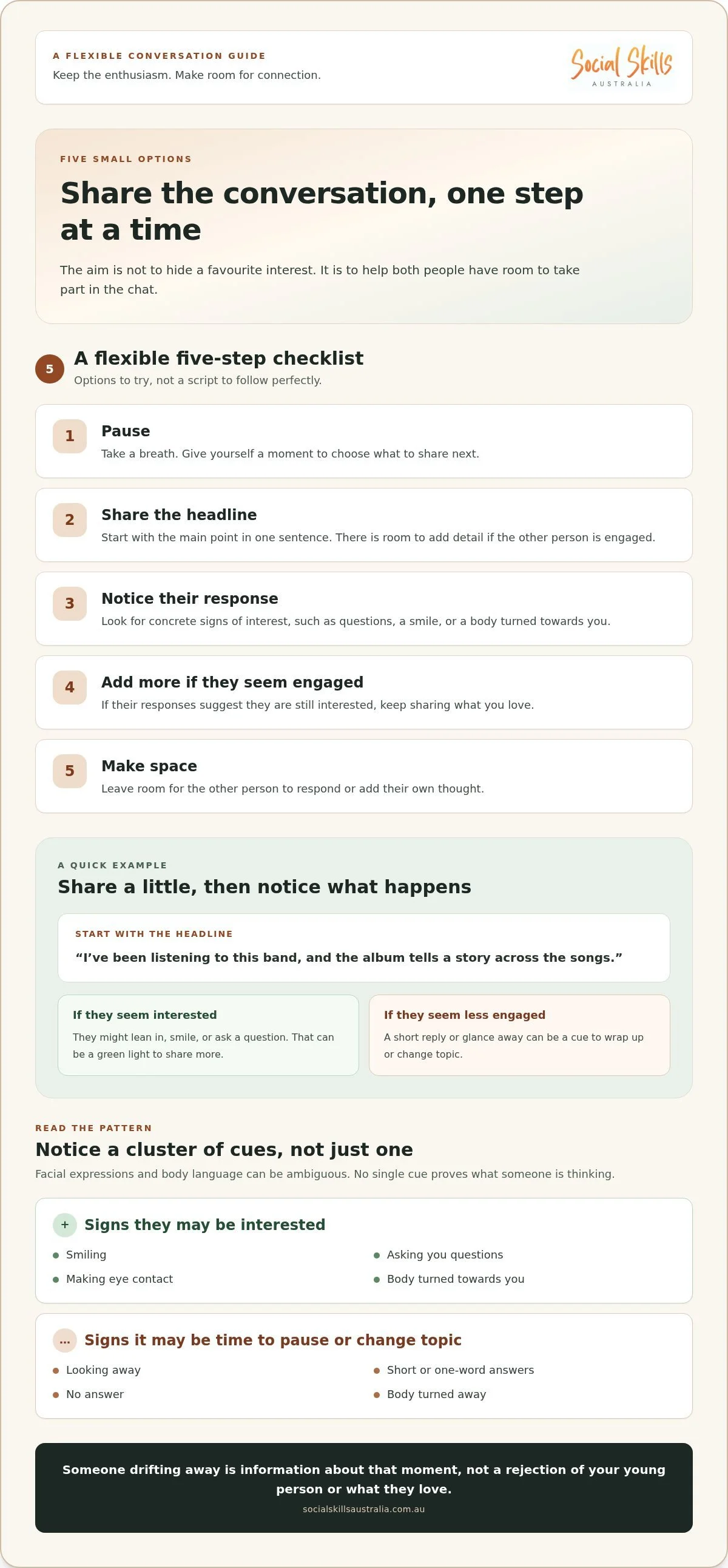
These five small steps are options, not a script to follow perfectly:
Pause. A breath gives you a moment to choose what to share next.
Share the headline. Start with the main point in one sentence.
Read their interest. Watch how they’re responding, are they engaged, or starting to drift?
Add more if they’re engaged. If their signals say they’re still interested, keep sharing.
Make space. Leave room for them to respond or add their own thought.
For example, someone might open with, “I’ve been listening to this band, and the album tells a story across the songs.” Then they watch how the other person responds: if they lean in, smile or ask a question of their own, that’s a green light to share more; if they give a short reply and glance away, it’s a sign to wrap up or change topic. If guided practice would help, explore Social Skills Australia’s programs and the next intake.
How to read whether someone’s still interested
You can’t know for certain from a single cue, and facial expressions can be ambiguous, so it helps to look for a cluster of concrete, observable behaviours.
Signs to keep going: they’re smiling, asking you questions, making eye contact, and their body is turned towards you.
Signs it might be time to pause or change topic: they’re looking away, giving short or one-word answers (or none at all), and their body is turned away.
No single one of these is proof, someone might glance away just to gather a thought, so it’s the overall pattern that matters. Your teen can read these signs and adjust as they go: share a little more when the signs are green, and ease off or change topic when they’re not. Someone drifting away is information about that moment, not a rejection of your young person or what they love.
Make room for connection, while keeping what you love
Learning how to stop info-dumping in conversations isn’t about hiding an interest. It’s about sharing the headline, reading how the other person is responding, and leaving room for their contribution. Start small: try one step in a familiar chat, then reflect together on what felt comfortable and mutual.
Social Skills Australia provides evidence-based, neurodiversity-affirming PEERS® programs online for teens and young adults across Australia. View the next intake to learn more.
If you'd like a place to start:
Download our free guide, 5 Steps to Making and Keeping Friends.
Book a free chat with me to talk through whether PEERS® is right for your young person. Enrolments are open for our January 2027 intake.
Frequently Asked Questions
Is info-dumping always a bad thing?
No. An enthusiastic, detailed explanation can be wonderful when the listener is interested and has room to join in. It only feels one-sided when the other person has little chance to respond. Rather than judging the amount of detail, consider whether both people have a turn.
Can info-dumping be related to autism or ADHD?
Some autistic and ADHD people share lots of detail to express excitement or connect over an interest, but experiences differ and not everyone communicates this way. Sharing a lot about a topic doesn’t, by itself, identify any condition.
How can I tell if someone wants me to stop talking?
Look for a pattern rather than one cue: short answers, looking away and a turned-away body suggest it’s time to pause, while smiling, asking you questions and eye contact suggest you can keep going. The goal is to read these signs and adjust as you go, not to put the other person on the spot.
Social Skills Australia delivers UCLA’s evidence-based PEERS® program online for teens and young adults with autism and ADHD across Australia.

Article by
Christine O'Leary
Christine O'Leary is the founder of Social Skills Australia, a Social Communication Educator and a UCLA PEERS® Certified Provider. She brings more than 28 years of communication experience across education, parenting support and consulting, and holds a Graduate Diploma in Communication and a Bachelor of Business Administration from the University of South Australia.
Christine first discovered PEERS® as a parent, when her own son wanted help making friends, and completed the program alongside him. That experience led her to become certified in 2022. Today she and her team deliver evidence-based social skills programs online across Australia for neurodivergent teens and young adults, and have supported hundreds of participants and their families.
Her approach is neuroaffirming and practical: social challenges are skill gaps, not character flaws, and the right skills can be learned.