
Building Self-Esteem and Social Skills: A Neurodiversity-Affirming Guide
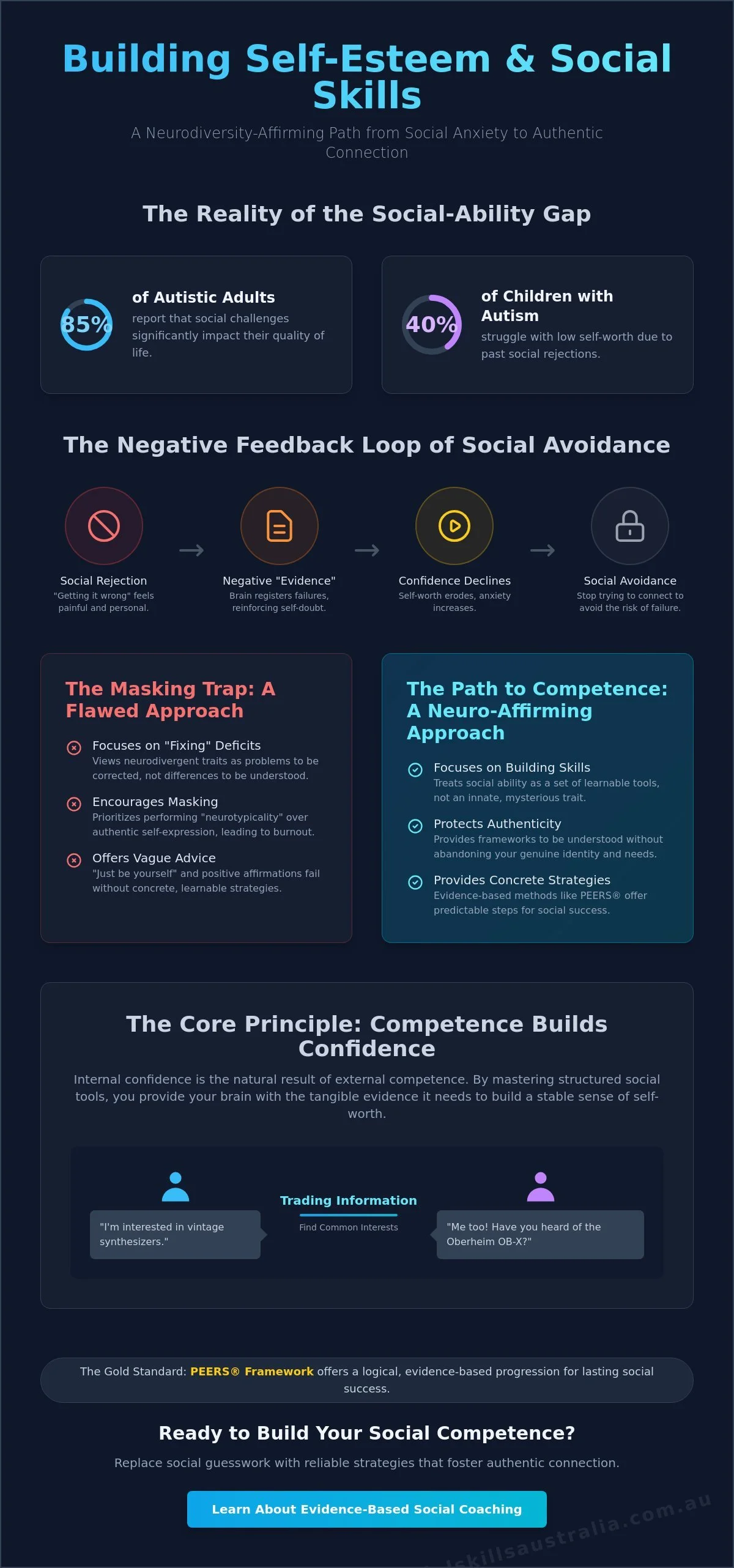
Did you know that 85% of autistic adults report that social challenges significantly impact their quality of life, while a 2024 study found that 40% of children with autism struggle with low self-worth? It's deeply painful to feel like a perpetual outsider or to carry the heavy weight of past social rejections. You deserve to move through the world without the constant, draining anxiety of "getting it wrong" in every conversation. We believe that building self-esteem and social skills isn't about "fixing" your personality; it's about providing the ecological validity and predictable frameworks you need to thrive as your authentic self.
In this guide, you'll discover how evidence-based interventions foster genuine confidence and help you form meaningful connections that respect your natural way of interacting. We'll explore the logical progression of the PEERS® framework and how it transforms social cognition into a practical tool for empowerment. By focusing on competence rather than forced performance, you can reduce social overwhelm and begin developing a stable sense of self-worth based on your unique strengths.
Key Takeaways
Learn how social competence acts as the tangible evidence your brain needs to shift from self-doubt to a positive internal evaluation of your worth.
Understand why performing "neurotypicality" or masking can erode your confidence and how a neurodiversity-affirming approach protects your dignity.
Discover how building self-esteem and social skills involves dismantling the belief that social ability is an innate trait rather than a learnable, structured set of tools.
Master the concrete strategy of "trading information" to find common interests and initiate conversations without feeling intrusive or overwhelmed.
Explore why the PEERS® framework is the gold standard for social coaching, offering a logical progression that provides more predictability than general life coaching.
The Vital Link Between Building Self-Esteem and Social Skills
Self-esteem is the internal evaluation of your own worth and capability. It is the quiet internal audit that determines whether you feel like a valued member of a community or an outsider looking in. For neurodivergent individuals, this internal audit is often based on years of social data. When you experience repeated social rejection, your brain registers these moments as evidence of a lack of capability. This creates a "Social-Ability" gap; a state where social success, which is a core pillar of human well-being, feels perpetually out of reach. This isn't just a clinical observation. It's a lived reality for the 85% of autistic adults who report that social interaction difficulties impact their quality of life.
The relationship between building self-esteem and social skills is symbiotic. Social competence provides the "evidence" your brain requires to sustain a positive self-view. Without the tools to navigate social landscapes, many individuals fall into a cycle of avoidance. They stop trying to connect because the risk of "getting it wrong" feels too high. This avoidance leads to a decline in confidence, which in turn makes the next social attempt even more anxiety-inducing. Breaking this cycle requires more than just encouragement; it requires a structured acquisition of skills that provide predictable results.
The Feedback Loop of Social Confidence
Psychologically, successful interactions reinforce a sense of belonging. Your social cognition, the way you process, store, and apply information about other people, influences how you perceive yourself within a group. When you successfully use a social tool, such as identifying a common interest, your brain records a successful outcome. This mastery directly translates into internalised self-worth. Internal confidence is the natural result of external competence.
Why "Positive Affirmations" Often Fail Without Skill-Building
Many people are told to "just be yourself" or to use positive affirmations to boost their mood. However, for someone who doesn't fundamentally understand what are social skills in a tactical sense, these suggestions are ineffective. Telling someone to be confident without giving them the "how" is like asking someone to drive a car without lessons. It's the difference between a "feel good" approach and a "competence-first" approach. We believe that social skills aren't innate mysteries but are instead learnable, predictable patterns. By focusing on building self-esteem and social skills through evidence-based frameworks, you replace social guesswork with reliable strategies that foster authentic connection.
A Neurodiversity-Affirming Approach to Social Competence
Traditional interventions often operate under a medical model that views neurodivergent traits as deficits to be corrected. This approach is fundamentally flawed. It prioritises social compliance over individual well-being, often forcing individuals to "mask" their natural tendencies to fit a neurotypical standard. Research indicates that 80% of autistic adults experience clinically significant anxiety, and much of this is driven by the persistent pressure to perform. When we shift the focus to building self-esteem and social skills through a neurodiversity-affirming lens, we stop trying to "fix" the person and start providing them with the tools to navigate a world that wasn't necessarily built for them.
Masking, or the constant effort to suppress neurodivergent traits, comes at a high cognitive and emotional cost. It leads to burnout and a persistent feeling of being an imposter. True social success isn't about how well you can imitate someone else; it's about how effectively you can express your needs and connect with others as your genuine self. This paradigm shift ensures that individuals and families feel seen rather than diagnosed, moving toward a collaborative model of empowerment.
Authenticity vs. Masking in Social Settings
Social masking is a survival strategy, but it's one that often results in a fractured sense of self. When you spend all your energy monitoring your body language or tone of voice, there's little room left for authentic connection. Structured coaching provides a middle ground. It offers clear frameworks to help you be understood by others without requiring you to abandon your identity. This approach emphasises finding "your people"—those who value your unique perspective and shared interests—rather than trying to appeal to everyone.
Social Skills as a Tool for Empowerment
Think of social rules not as a set of moral imperatives, but as a "second language" that can be mastered. This perspective gives you agency. You aren't learning these skills because you are "broken"; you're learning them to increase your options and autonomy. We focus on ecological validity, ensuring that the strategies taught are those that actually work in real-world Australian social contexts.
By mastering these patterns, you gain the right to choose when and how to employ them. This is the heart of building self-esteem and social skills: the power to engage on your own terms. If you're looking for a supportive environment to explore these tools, our evidence-based programs offer a collaborative path toward meaningful connections. This empowerment model recognises that your neurodivergent traits are not barriers to friendship, but unique ways of experiencing the world that deserve respect and validation.
Overcoming the Barriers to Social Confidence
Many individuals believe that social grace is an innate talent, something you're either born with or you aren't. When you've spent years feeling like an outsider, it's easy to adopt the belief that you're "just naturally bad at this." This mindset is often a protective response to a history of social rejection. If 85% of autistic adults report significant difficulties with social interaction, it's clear that the challenge isn't a personal flaw; it's a systemic lack of appropriate, structured support. Building self-esteem and social skills requires first dismantling the myth that social ability is a fixed trait. It's a set of skills that can be broken down, practiced, and mastered through evidence-based methods.
Past trauma and social rejection often leave deep scars on a person's self-worth. When social environments have felt unpredictable or hostile, your brain naturally prioritises safety over connection. This leads to a cycle of avoidance that prevents you from gathering the positive social data needed to feel confident. To move forward, we must address the specific barriers that make socialising feel like a high-stakes performance rather than a way to find belonging.
Managing Social Anxiety and "Nerves"
Up to 50% of autistic adults experience clinically significant anxiety, which often peaks before social events. Tactical strategies, such as deep pressure techniques or planned sensory breaks, can help calm the nervous system. Using predictable social scripts also reduces the fear of the unknown. It's vital to distinguish between clinical social anxiety, which is a fear of judgment, and sensory overwhelm, which is a physiological response to an environment. Recognising this difference allows you to apply the right tool for the specific challenge you're facing.
Handling Rejection and Teasing with Resilience
Resilience isn't about never feeling hurt; it's about having a plan for when things don't go as expected. Evidence-based social coaching, such as the PEERS® framework, teaches specific, "cool" comebacks to teasing that neutralise the interaction without escalating conflict. Reframing rejection as a lack of "fit" rather than a personal failure is a core part of building self-esteem and social skills. You don't need to be liked by everyone to have a high quality of life. By learning from social mistakes without spiraling into self-blame, you protect your dignity while continuing to seek out the meaningful connections you deserve.
Practical Strategies for Building Authentic Connections
While mindset shifts are essential, building self-esteem and social skills depends heavily on mastering the concrete mechanics of human interaction. A 2022 study demonstrated that structured social skills training can boost the overall well-being of neurodivergent individuals by 35%. This improvement occurs because social situations transition from being sources of unpredictable stress to manageable, structured events. Instead of relying on vague advice to "just be yourself," we focus on ecological validity; the specific, real-world actions that lead to successful outcomes.
Successful socialising isn't a performance of neurotypicality. It's a set of tools used to find people who share your interests and values. When you have a predictable framework for how to start a conversation or join a group, the anxiety of "getting it wrong" begins to dissipate. This predictability allows your authentic personality to emerge because you aren't spending all your cognitive energy trying to guess the unspoken rules of the room.
The Art of Initiating and Maintaining Conversations
Entering a conversation is a multi-step process that begins with assessing the social landscape. Before speaking, observe the group's body language and the flow of their talk. Are they in a tight circle, or is there a "green light" like an open physical space or a lull in the discussion? Once you've identified an opening, the goal is "trading information." This is a mutual exchange where you share a small detail about yourself and ask an open-ended question to encourage the other person to do the same. This process isn't about interviewing; it's about finding common ground that anchors the relationship and provides a reason for future interaction.
Building the "Friendship Pyramid"
Friendships don't happen instantly; they follow a logical progression from greetings to brief acquaintances before moving toward shared activities. Shared interests act as a low-pressure anchor for socialising, allowing the focus to remain on a common task rather than just the interaction itself. To move up the pyramid, practice "checking in" with potential friends through brief, low-stakes messages or invitations. This methodical approach ensures you're building self-esteem and social skills through repeatable successes rather than social guesswork.
If you're ready to apply these strategies in a way that respects your natural way of interacting, our Young Adult Program provides the structured, evidence-based environment needed to foster these meaningful connections.
The PEERS® Methodology: A Path to Lasting Social Success
The PEERS® (Program for the Education and Enrichment of Relational Skills) framework is the gold standard for social coaching. Unlike general life coaching, which often relies on anecdotal advice or vague encouragement, PEERS® is a rigorous, evidence-based intervention originally developed at UCLA. It focuses on building self-esteem and social skills by teaching ecologically valid strategies that have been scientifically proven to work in real-world settings. Over a 14-week period, this structured approach transforms social cognition from a source of confusion into a predictable set of tools that empower the individual.
A unique and vital element of this methodology is the involvement of a "Social Coach," typically a parent or caregiver. This collaborative model ensures that the skills learned during the sessions aren't confined to a digital classroom. By having a coach to support real-world practice, the individual receives immediate, supportive feedback in their natural environment. This support system is essential for ensuring that new habits stick and that the individual feels seen and supported throughout their journey toward social competence.
Why Structure Matters for Neurodivergent Learners
Neurodivergent learners thrive when complex social interactions are broken down into concrete, repeatable steps. PEERS® does exactly this, removing the ambiguity that often leads to social anxiety and overwhelm. Our 14-week Adolescent and Young Adult programmes are delivered via telehealth, which significantly reduces the barrier of social anxiety by allowing participants to learn from the safety of their own homes. This virtual delivery model provides a sense of predictability and control, which is essential for effective learning and building self-esteem and social skills.
Investing in Meaningful Connections
Improving your social-ability is an investment in your long-term quality of life. The ultimate goal isn't social compliance; it's the creation of meaningful connections that bring joy and a sense of belonging. When you master these evidence-based patterns, you aren't just learning how to talk to people; you're learning how to build a life filled with authentic friendship and confidence. It's time to move from simply understanding your social challenges to taking decisive action toward a more connected future.
Explore our evidence-based social skills programmes today.
Fostering Belonging Through Evidence-Based Skills
The journey toward meaningful connections begins with the recognition that your social identity is valid and your skills are expandable. By focusing on building self-esteem and social skills, you move away from the exhaustion of masking and toward the empowerment of genuine interaction. We've explored how structured, evidence-based frameworks provide the predictability necessary to navigate complex social landscapes with confidence. This transition from social uncertainty to mastery is a collaborative process that respects your dignity and autonomy at every step.
Social Skills Australia provides the professional support you need through our certified PEERS® providers and a neurodiversity-affirming framework. Our evidence-based 14-week curriculum is designed to deliver ecological validity while maintaining nationwide telehealth accessibility for your comfort. This methodical approach ensures that the progress you make is sustainable and deeply rooted in your own unique strengths. You don't have to navigate these social complexities alone. We're here to act as your knowledgeable ally, bridging the gap between clinical rigor and your lived experience.
Join an evidence-based PEERS® social skills group today and begin building the authentic friendships you deserve.
Frequently Asked Questions
Is it possible to learn social skills as an adult?
Yes, social cognition remains adaptable throughout adulthood, allowing for the acquisition of new communicative frameworks at any stage of life. Our self-paced Over 30’s Social Skills Course is designed specifically for this demographic, providing the ecological validity needed for professional and personal success. While childhood is a period of rapid learning, adults often bring a higher level of motivation and self-awareness to the process of building self-esteem and social skills.
How long does it take to see improvements in self-esteem?
Measurable shifts in self-worth often emerge within the first 4 to 6 weeks of a structured program as individuals begin to experience repeatable social successes. A 2022 study highlighted that evidence-based training can lead to a 35% increase in overall well-being for neurodivergent participants. This improvement is a direct result of replacing social guesswork with predictable strategies, which reduces anxiety and builds a stable foundation for authentic confidence.
What is the difference between social skills training and general therapy?
Social skills training is a psychoeducational intervention that prioritises the mastery of concrete, tactical steps for interaction, while general therapy typically focuses on emotional processing or trauma resolution. While therapy might explore why a person feels anxious, a program like PEERS® provides the specific scripts and rules for initiating conversations or handling teasing. This focus on competence over contemplation is what distinguishes evidence-based coaching from traditional medical models.
Can online social skills courses be as effective as in-person groups?
Research into telehealth delivery has confirmed that virtual social skills training is just as effective as in-person sessions, with the added benefit of reduced sensory overwhelm. For many neurodivergent individuals, learning from a safe, controlled environment like their own home allows for better focus and retention of the 14-week curriculum. This digital accessibility ensures that individuals across Australia can access certified PEERS® providers without the added stress of travel or unfamiliar physical spaces.
How can I support my neurodivergent teen without making them feel "broken"?
Support your teen by reframing social strategies as a "social toolkit" or a "second language" that grants them more autonomy in their interactions. Our Adolescent Program uses a collaborative model that involves parents as social coaches, ensuring the focus remains on empowerment rather than correction. This neurodiversity-affirming approach validates their natural way of being while providing the skills needed to find "their people" and build meaningful connections.
What happens if I make a social mistake while practicing new skills?
Social mistakes are viewed as essential data points in the learning process rather than reflections of your character. Within a structured framework, we teach specific strategies for recovery, such as how to exit a conversation gracefully or how to use a "cool" comeback if a situation becomes awkward. Learning these recovery tools is a core part of building self-esteem and social skills, as it reduces the fear of failure and encourages continued social engagement.
How does the PEERS® program differ from other social skills curricula?
The PEERS® framework is distinguished by its heavy emphasis on ecological validity, meaning it teaches the actual rules that socially successful people use in the real world. Unlike other curricula, it is the only parent-assisted, evidence-based intervention that has been validated by over 30 peer-reviewed studies. This scientific rigor, combined with its 14-week structured duration, ensures that the skills being taught are both practical and durable over the long term.
Does NDIS funding cover social skills coaching in Australia?
NDIS funding often covers social skills coaching when it's aligned with a participant's goals for increased social and community participation. Many families use their "Capacity Building" budget to fund our Adolescent or Young Adult Programs, as these evidence-based interventions directly support independence and well-being. We recommend checking your specific plan or consulting with a Support Coordinator to confirm how these services fit within your current funding allocation.